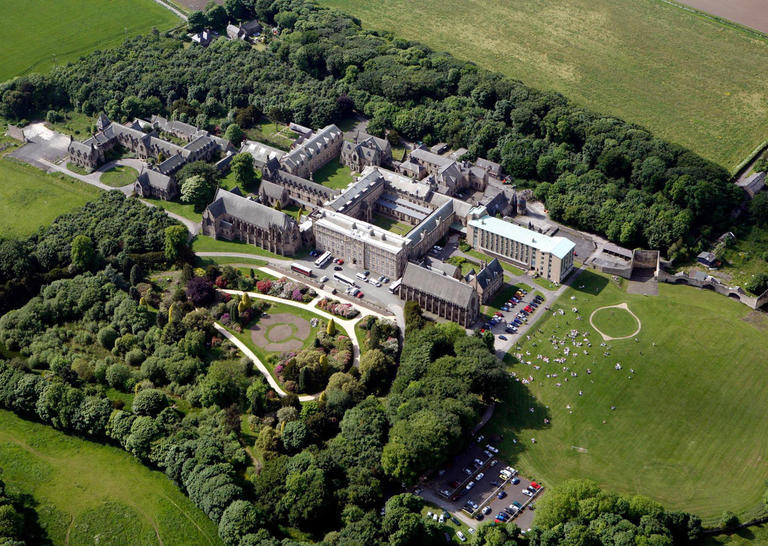
Study Mathematics - MMath at Durham University in the UK,
ip target image
You are currently browsing our site with content tailored to students in your country

Mathematics - MMath

UK

11

What will I learn?

Take your mathematical knowledge to a higher level – the MMath is ideal preparation for a career involving research or high-level mathematical skills. This challenging four-year course takes your study to Master’s level. This course is ideal if you are considering postgraduate study or a career involving high-level mathematical skills or research. During the first two years you will follow a similar structure to the BSc. From the third year the MMath introduces a wider range of modules which explore more sophisticated methods of mathematical argument. The MMath in Mathematics is housed in a brand-new facility, purpose-built to meet the learning, teaching and study needs of students from the Department. When you choose maths you’ll be taught by a team of mathematicians with a passion for sharing the beauty of mathematics and a wealth of experience in research across the spectrum of pure and applied mathematics and statistics. And with many of the teaching team actively involved at the forefront of research, the degree is designed to link learning to research in distinctive and creative ways. You can also apply to add a placement year or a year abroad to your degree, increasing the course from four years to five.The first year of the course begins with a broad-based introduction to pure and applied mathematics, statistics and probability and provides a sound foundation for in-depth study in subsequent years. In the second and third years the structure offers more flexibility, enabling you to shape your degree around one specific area or continue developing your skills across a wide range of subjects. During the final year the range of optional modules expands further, introducing more advanced concepts and theories. The degree culminates in a double-module project that gives you the opportunity to investigate a mathematical topic of interest in depth.Course structureYear 1 modulesCore modules:Calculus builds on ideas of differentiation and integration in A level mathematics, beginning with functions of a single variable and moving on to functions of several variables. Topics include methods of solving ordinary and partial differential equations, and an introduction to Fourier Series and Fourier transforms.Linear Algebra presents mathematical ideas, techniques in linear algebra and develops the geometric intuition and familiarity with vector methods in preparation for more challenging material later in the course.Analysis aims to provide an understanding of real and complex number systems, and to rigorously develop the calculus of functions of a single variable from basic principles.Programming is taught via lectures and practical sessions that introduce basic principles and basic competence in computer programming. You will also study control structures floating point arithmetic and lists, strings and introduction to objects.Dynamics develops an understanding of elementary classical Newtonian dynamics as well as an ability to formulate and solve basic problems in dynamics.Probability introduces mathematics ideas on probability in preparation for more demanding material later in the course. The module presents a mathematical subject of key importance to the real-world (applied) that is based on rigorous mathematical foundations (pure).Statistics introduces frequentist and Bayesian statistics and demonstrates the relevance of these principles and procedures to real problems. This module lays the foundations for all subsequent study of statistics.Year 2 modulesCore modules:Complex Analysis introduces the theory of complex analysis through the study of complex differentiation conformal mappings metric spaces series and uniform convergence contour integrals and calculus of residues and applications.Analysis in Many Variables provides an understanding of calculus in more than one dimension, together with an understanding of, and

Study options

Full Time (4 Years)

Tuition fees
£10,050.00 (US$ 12,979) per year
This is a provisional fee yet to be approved

*Price shown is for indicative purposes, please check with institution

Start date

September 2027

Venue

Main Campus

Palatine Centre,

Durham,

DH1 3HP, Northern England, United Kingdom

Entry requirements

For international students

A level offer – A*A*A–A*AA.Suitable performance in the University Admission Tests TMUA or MAT or 2 in any STEP will lead to the lower A*AA offer (A*A in Mathematics and Further Mathematics, either way round plus A in any other A level or equivalent). Otherwise the standard offer is A*A*A (A*A* in Mathematics and Further Mathematics plus A in any other A level or equivalent).BTEC Level 3 National Extended Diploma/OCR Cambridge Technical Extended Diploma – D*D*D – D*DD and A level requirements as above.IB Diploma score – 38 with 776 including a 7 in Mathematics (Analysis & Approaches) or 766 in higher level subjects, including a 7 in Mathematics (Analysis & Approaches)

*There may be different IELTS requirements depending on your chosen course.

Add to my favourites

Product of

Have you discovered our IDP community?

Get to hear first-hand experiences from past students, join groups and more with our new community feature!

View community now!
cta banner image

About Durham University

Durham University connects a rich history with modern values to create a well-respected and forward-thinking institution.

  • Durham hosts over 18,000 students from across the world
  • Named top 30 international university in the world
  • Durham is one of the top 5 universities in the UK
  • The university received the TEF gold teaching standard

Get in touch